

Critics of the Bible often claim that the resurrection accounts in the four Gospels contradict each other. While it’s true they are not identical, different does not mean contradictory. Instead, these various accounts complement each other and broaden our understanding.
I’ve seen police dramas in which the investigators doubt the testimony of two eyewitnesses whose accounts are exactly the same. Why do they doubt? Because identical indicates the witnesses collaborated and rehearsed their stories. But complementary stories that share different details ring true because every individual experience does vary. Each person sees unique aspects and encounters the same event from a different perspective.
Do We Really Need Four Gospels?
For the last several months I’ve been teaching through the Gospel of John in a Sunday morning adult Bible study class. In our first week, we discussed the purpose, themes, and structure of John’s account. The content clearly aligns with his stated purpose for writing (John 20:30-31). (By the way, if you would like to study the Gospel of John, I’d be honored if you’d check out my study “Deep Rooted: Growing through the Gospel of John.“)
Under the inspiration and guidance of the Holy Spirit, Matthew, Mark, Luke, and John each selected what to include in their Gospel account. They shaped that material to meet their purpose and address the needs of their specific audience. If the Gospel authors included the same events, each focused on different aspects to support their overall purpose. (Also see “7 Ways John is Different from the Synoptic Gospels.”)
While each Gospel is unique and distinct, they do not contradict. Rather they complement one another. Together they provide a more comprehensive picture and deeper understanding of Jesus, His nature, His teaching, and His mission.
“Read Horizontally” Across the Gospels
Last week in our class we studied John’s account of Jesus’ resurrection found in chapter 20 of his Gospel. As part of my preparation, I read and compared all four resurrection accounts to get a broader understanding of what happened on the first Easter Sunday. (Also see “The Cross is Not Enough: Five Reasons We Need the Resurrection.”)
This strategy is an effective and practical way to better understand any passage from one of the Gospels. When an event or teaching we are studying in one Gospel is also recorded in one or more other Gospels we should also read those and compare. This study tool, sometimes referred to as “reading horizontally,” means we read across the Gospels. You can do this by separately looking up the event in each Gospel or by using a special resource known as a “Synopsis of the Four Gospels.” (Also see “4 Tips for Understanding the Gospels.”)
An Example from the Resurrection Accounts
If you’ve read about Jesus’ resurrection from more than one Gospel, you probably noticed that there are differences. None of the four Gospel writers tell this miraculous event the same. They each share different details and present things in a slightly different order.
To see the big picture of the resurrection, I read all four Gospel accounts. I noticed that although each author shared different specifics, sometimes in a slightly different order, they all included the same basic information in five specific areas:
- Women were the first to visit the tomb on Sunday morning.
- The women discovered an open, empty tomb, and encountered angels.
- The angels gave instructions to the women.
- The women reported to the disciples.
- Jesus appeared to His disciples and others, confirming His resurrection.
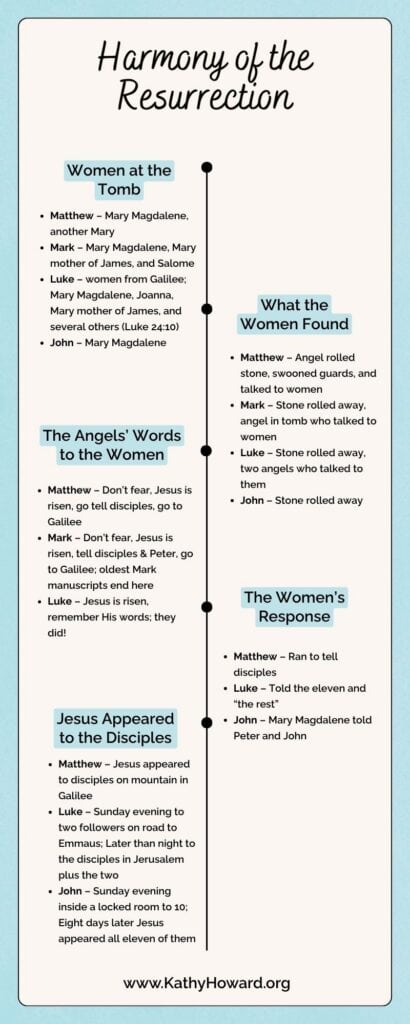
I started five lists, one for each of the broad areas above. Then I read each Gospel and added the specifics from each to the appropriate list. You can use this same process with any event or teaching in the Gospels. These lists reveal both similarities and distinctions. (The image to the right shows the basics of the lists I created.)
The differences in the details do not prove contradiction but instead are typical examples of eyewitness accounts. For instance, John wrote the Mary Magdalene went to the tomb first on Sunday morning. The other three Gospel writers all cite Mary Magdalene but also mention others. John did not exclude other women, he only specifically mentioned Mary Magdalene.
When the four accounts are examined side by side, we find harmony on the essentials and variation on the details. This aligns with authentic, eyewitness testimony. Yes, the Gospels are different. And yes, the Gospels tell the same story. Four eyewitness accounts, one glorious truth.
The image to the right links to a PDF version of this infographic. If you’d like, feel free to download and print it for reference! Or you can also CLICK HERE for the PDF!
What is your favorite Gospel story?
Titus Bible Study
Join Kathy's mailing list to receive a free mini Bible study on the book of Titus.
Success! Check your inbox for the download link.